Some people suggest learning different religions to increase tolerance. Further, learning about different religions can give us a new perspective on how we see the world.
Learning new religions can give us inner alignment, and we will not be trapped in one dogma. Also, we can see different perspectives in “The only one way of truth.”
But, I have a different opinion. On the contrary, I have not recommended you to do it. But, precisely I recommended you do not learn different religions for some reason.
What I tell here is based on my experience. We have a different perspective, and this is my perspective based on our experience.
My perspective began at junior high school when I asked, “Why do so many people pray to the wrong god? Their religion is illogical at all. So why do all of them believe it?”
I am a Muslim, and this question made me learn Christianity. However, I still don’t understand why they prayed for my prophet (Jesus) after learning it. And also learn Buddhism, Hinduism, Atheism, and others.
I am starting the same question for my religion: “Why do I believe in this god, not another god? How will it be if I am born in a non-Muslim family? How can I find the correct religion?”
I was starting to learn from skeptical people about Islam. So many of the arguments are based on unknowing about Islam.
So I started to form the root of the truth. What is truth, and how can we achieve the truth? After it, I can compare the teachings of these religions with the truth.
The problem is many versions of the truth, from Plato, who talks about the ideal world, to Aristoteles, who talks about materialism. So I must find “the best truth version” and then use it to determine who is right and wrong, which is the right religion and other not.
I can know the right religion by comparing the teaching with the truth. But, how can I know “the best truth version.”? (Read about ontology and epistemology if you want to know about this topic.)
And I choose materialism as the truth.
Materialism believes that what exists in this world only matters and nothing else. You can see your gadget now because your gadget is out there, not just a sensation or illusion in mind.
To confirm the existence of your gadget, you can use your various senses. In addition, you can also use tools to be able to prove that your gadget exists.
Materialism only talks about the matter and doesn’t discuss anything beyond it. So then, how can materialism be relied upon to test an essentially immaterial religion?
All religions talk about the actions of a god or immaterial being who has a powerful influence on the material realm. From there, we can see, measure, and compare which gods influence the physical realm and which do not.
Materialism and empiricism are the cornerstones of modern scientific methodology. If the theory can’t be proven empirically with the human senses or by tools, then the theory is rejected.
Ether is a physical concept that has succeeded in explaining the behavior of light. But the existence of the ether cannot be proven even if it is pretty logical to think about it. However, this concept was never used, and recently, a new concept was discovered, which was proven empirically true.
After discovering the truth, I used it to find out which religion is the most correct.
The results took me by surprise.
- There is no correlation between human behavior and natural events.
- All religions discuss immaterial things, which cannot be proven at all.
- There is no evidence of immaterial behavior.
Realizing this, I became increasingly afraid, confused, and frustrated. The project from the very beginning to find the correct teachings ended up deadlocked. It’s like I’m chopping a tree trunk while I’m still on it.
I can not explain in detail how bad emotions I experienced at that time. It feels like if I could go back in time, I would choose not to start looking for those questions.
This experience is the reason I used to persuade you not to study other religions. If you want to increase tolerance, learn from people whose religion is different from yours.
All of us believe that our religion comes from God and others do not. We are correct, and otherwise, not without testing it at all.
That’s why “faith” is so emphasized in religion because even if we don’t see immaterial, we must believe that astral beings exist, care about us, live with us, are more powerful than us, and we must believe that.
Finally
Scientifically the existence of immaterial is very unscientific, but the absence of immaterial is also unscientific. This is where all religions emerge to answer this problem. Religion answers human nature, human goals, and where humans will end up.
Religion provides answers that no other research laboratory can provide.
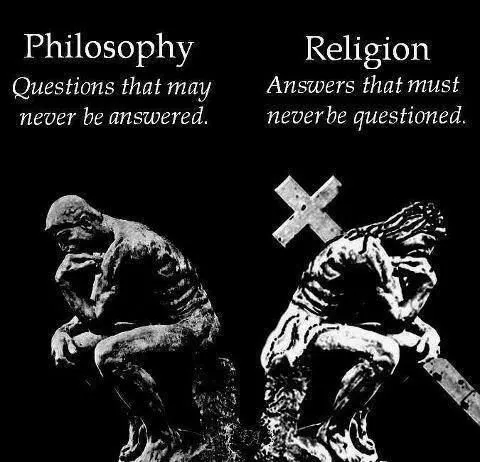
Every religion has a concept that must be believed and has a definite answer. As religious people, we must believe, not oppose it, and not ask it to find alternative answers that contradict the basic idea of religion. We call it dogma.
But what’s wrong with dogma? Why You Should Trust in Dogma
*postingan ini dipublikasikan juga disini -> https://medium.com/@mukhlisinfo/i-learn-differences-religions-and-not-recommend-you-to-do-it-eed046babbd